
Hanmac News
Jangheon Engineering & Construction’s ‘Pre-Deck Construction Method’ gains attention for significantly reducing Construction Time and Costs
2018 . 11.21
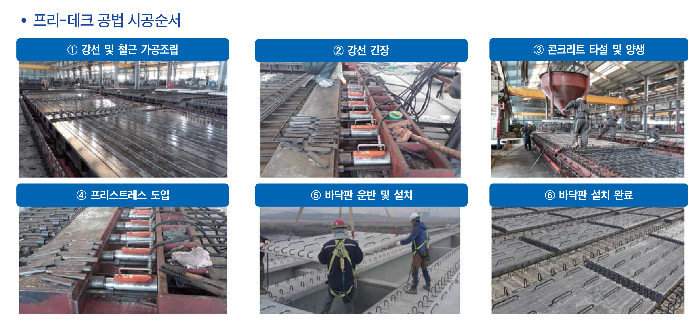
A method that applies an innovative prestressing technique to steel bars—similar to the approach used in composite girders—within a precast half-deck has
recently been certified as a New Excellent Technology in the construction field, drawing significant attention. The technology in the spotlight is Jangheon
Engineering & Construction’s (CEO Seo Seong Yeol) “Pre-Deck Method,” officially named “Pretensioned Half-Slab Precast Concrete Deck Construction Method Using
Deformed Steel Bars with Enlarged Round Heads and Coupled Anchorage System.” Developed jointly with Hanmac Engineering, PTC, Saman, and Halla, the Pre-Deck
Method was recently designated by the Ministry of Land, Infrastructure and Transport as New Excellent Technology No. 852. Jangheon Engineering & Construction
already holds three other NET(New Excellent Technology) certifications related to girders: DR Girder (No. 582), which ranked first in nationwide utilization
performance in 2016 and 2017; Pretensioned PSC I-Girder (No. 752); and Nodular Girder (No. 812). Unlike its previous technologies, the newly certified invention
is not girder-related but instead focuses on slab(deck) construction.
The “Pre-Deck Method” applies prestressing technologies, that have been used in steel–concrete composite girder, and precast technologies. In composite girder
construction, steel bars embedded in the concrete are tensioned to enhance durability. The Pre-Deck Method follows the same principle: steel bars are placed,
concrete is cast and subsequently prestressed to increase the deck’s structural performance. However, the Pre-Deck Method incorporates an additional innovative
feature. In conventional prestressing, the steel bars are tensioned by pulling them, but during the concrete curing process, the bars tend to move inward naturally,
causing a loss of prestressing force. To address this, the Pre-Deck Method installs anchorage devices at both ends of the steel bars and forms the bar tips with
enlarged, rounded heads. When the bars attempt to pull inward during curing, they are mechanically locked by the anchorage system. This configuration minimizes
the loss of prestressing force and significantly improves overall durability.
Another advantage of the Pre-Deck Method is that it allows for factory production(precast). Deck panels are manufactured in advance at the factory,
typically 2.4 to 3 meters in length and 110mm in thickness. At the construction site, the transported precast panels are simply installed sequentially,
which significantly shortens the construction time. In addition, this helps maximizing product quality in relation to deck-slab cracking. The nut-shaped
anchorage device is also equipped with connecting bolts. This feature minimizes interference between adjacent deck panels during installation and enables
easy and reliable connection in the field.
In bridge construction, most deck slabs have traditionally been built on-site by placing reinforcement, installing formwork, and casting concrete. Although
precast options have existed, they still required rebar placement similar to on-site construction, and when steel bars were used, they tended to move inward
during curing, resulting in reduced durability.
Jangheon Engineering & Construction’s Pre-Deck Method effectively resolves these field issues. Compared to conventional cast-in-place construction, the method
shortens the construction time by approximately 40 days and reduces construction costs by about 14%. Compared to existing prestressed deck systems, it delivers
superior cost efficiency by reducing the required amount of reinforcing steel.
The Pre-Deck Method has already been applied at nine construction sites, including the Namgye Bridge on Section 1 of the Jeokseong–Jeongok project ordered by
the Seoul Regional Land Management Office (completed in 2016). It is said that the method received high satisfaction from project owners. A representative from
Jangheon Industry stated, “In addition to shortening the construction schedule and reducing costs, the Pre-Deck Method allows for factory production, which also
lowers social costs by reducing construction waste and minimizing safety hazards. We are confident that this method enhances structural stability without compromising
constructability, giving it strong competitiveness not only in domestic construction markets but also overseas.”
Source: Daehan Gyeongje, Reporter Jeong Hoe Hoon
(translated from Korean article)