
Hanmac News
Nodular Girder – Construction New Technology No. 812
2017 . 03.29
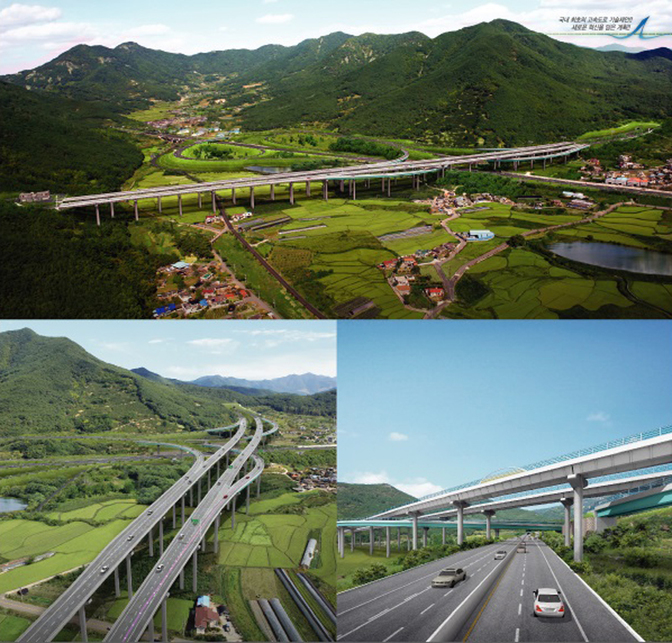
The Nodular Girder developed by JANGHEON Industry Co., Ltd. is designated as Construction New Technology No. 812.
By applying pre-tensioned precast concrete members, the system minimizes on-site work and enables rapid construction.
In particular, the use of a socket connection system allows formwork-free wet joints between precast members, ensuring reliable
connections and demonstrating a dependable PSC girder fabrication and erection technology.
From a technical perspective, transportable precast concrete members are fabricated in a factory and assembled on-site, where member
connections are completed through cast-in-place concrete wet joints without the need for formwork.
This approach improves efficiency in transportation, lifting, and installation, significantly reducing on-site labor and construction
time while enhancing the reliability of connections between precast members.
In response to increasing on-site workloads, limited availability of skilled labor, and shortened construction schedules, JANGHEON Industry’s
technology offers an effective solution to these challenges.
From a structural safety perspective, conventional systems often rely on friction-based connections between precast members, which can lead
to structural limitations.
In contrast, JANGHEON Industry’s technology ensures structural safety by enabling direct concrete casting and wet joint connections between
precast members without the need for formwork.
In terms of constructability, conventional girder fabrication typically requires complex processes such as rebar cage assembly and sheath
duct installation prior to formwork erection.
JANGHEON Industry’s system simplifies this workflow by allowing straightforward assembly of precast members.
Furthermore, for PC panel installation, the technology advances conventional methods that require additional cantilever support and formwork
by enabling installation across the entire span, improving construction efficiency.
As a result, the system minimizes initial construction time—particularly for spans of 40–60 meters—and reduces maintenance requirements
through the use of internal inspection spaces and maintenance walkways.
In addition, high-quality performance is ensured through the use of high-strength concrete (60 MPa) and precast fabrication, while overall
construction costs are reduced by minimizing on-site operations.
In terms of economic performance, the technology reduces construction costs by approximately 10–20% compared to I-type girders, depending on
fabrication scale, and shortens the construction period by 41%.
Specifically, material usage is reduced by approximately 32% for concrete, 3% for reinforcing steel, and 32% for prestressing strands,
while on-site labor input is reduced by 38%.
The technology has been applied to major infrastructure projects, including Section 6 of the Sangju-Yeongdeok Expressway and the Pyeongpal
Viaduct, completed in November 2015.
It was also selected as the winning proposal for the Sanoe Bridge on Section 1 of the Miryang–Ulsan Expressway in December 2014.
The system is currently being applied to the Gwangjae IC Bridge construction project on the Busan Outer Ring Expressway.
According to a representative from JANGHEON Industry, the technology can be effectively utilized for bridges requiring minimized on-site
operations—such as overpasses for private access or medium-span bridges—and can also be applied to rapid construction projects and overseas
markets where shortened construction time and economic efficiency are critical.
Source: Reporter Hong Jae-seok, Maeil Construction News
(translated from Korean article)